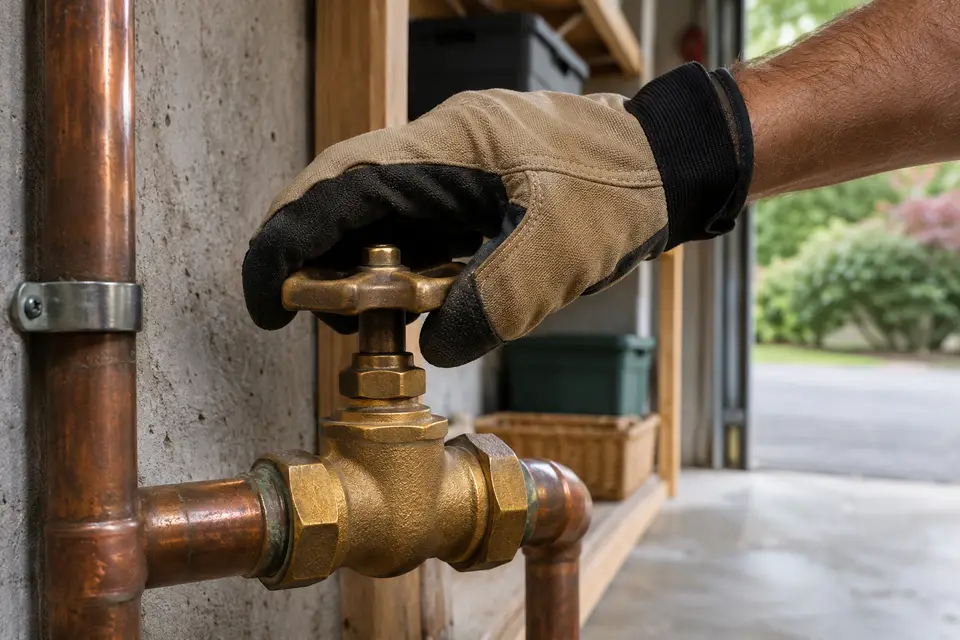
How to Turn Off the Water to Your House
Find your main valveLearn how to turn off water to the house before you need to, so a leak becomes a calm repair instead of a flooded room.
How to turn off water to the house at the main valve
Look wherever the supply pipe comes into the building. Around Oregon City, these spots turn it up most often.
- The garage
- Often low on the wall facing the street, sometimes near the water heater.
- A utility room or laundry room
- Near the water heater or the washer connections.
- The crawl space
- Just inside the access hatch, on the pipe coming up from the ground.
- A basement
- On the front wall where the line comes through the foundation.
- Outside the house
- Some homes have a valve on the outside wall or in a small box near the foundation.
No luck indoors? The valve at the meter by the curb cuts water to the entire lot.
How each type of valve turns
A round wheel handle
- Turn it right until it halts
- Expect a number of full turns
- Older wheel valves can be stiff or seep at the stem
- Do not force a wheel that will not move
A lever handle
- A quarter turn is all it takes
- Closed when the lever sits across the pipe
- Open when the lever runs along the pipe
- Usually easier to close quickly

Using the shutoff at the meter
The meter sits in a box in the ground near the street. Lift the lid carefully, since insects and water often collect inside.
- Look for a valve on the street side of the meter.
- It may need a meter key or a sturdy wrench to turn.
- Turn it a quarter turn so the handle sits across the pipe.
- If the valve looks damaged, leave it and call the water utility.
The meter box is also where you check for hidden leaks. Our running meter guide explains the test.
Shutoffs for single fixtures
Most fixtures have their own small valve, so you can stop one leak without turning off the whole house.
- Sinks
- A pair of little valves beneath the basin, hot on one side and cold on the other.
- Toilets
- A single valve low on the wall, or in the floor, behind the bowl.
- Water heater
- A valve on the cold supply pipe at the top of the tank.
- Washing machine
- A hot and a cold valve mounted behind the washer.
- Outdoor faucets
- Frequently its own valve indoors, close to where the pipe passes outside.
If a fixture valve leaks around its stem when you close it, tighten the small nut behind the handle a little. If it keeps leaking, it needs replacing. Our faucet and sink repair covers those valves.
When a valve will not budge
A valve left untouched for years can freeze in place, and wrenching on it may snap it and add a second leak.
- Try steady pressureTurn firmly by hand, without a long bar or hammer.
- Use the next valve outIf the house valve will not move, use the shutoff at the meter.
- Call before it is an emergencyA plumber can replace a seized valve with a new one that turns easily.
Replacing an old main valve is a small job that pays off the first time a pipe breaks.
Turning the water back on
Throwing the main wide open sends air and grit racing through the lines, so ease it open bit by bit.
- Close any taps you opened to drain the pipes, except one at the lowest point.
- Open the main valve slowly until water flows from that tap.
- Let it run until it flows smoothly, then close it.
- Check under sinks and around the repaired spot for drips.
If water appears anywhere new, close the main again and call. The burst pipe repair page explains what a plumber looks for after a break.
Make the valve easy to find
In an emergency, nobody wants to search. A few minutes now saves a lot of stress later.
- Tie a bright label to the main valve so anyone at home can spot it.
- Keep the area in front of it clear of boxes and storage.
- Show family members and house sitters where it is and how it turns.
- Keep a flashlight near the crawl space hatch if the valve is under the house.
After the water is off, the plumbing emergency first steps guide takes you through what comes next.
How the age of the house changes the valve
When a house was built often decides which main valve it has and how reliable it is.
Older homes
- Wheel handled gate valves that take many turns
- Valves that seize when they are never used
- Stems that drip once they are moved again
- Valves tucked into crawl spaces or basements
Newer homes
- Lever handled ball valves with a quarter turn
- Valves in the garage or a utility closet
- Fewer stuck valves, though they still need testing
- Sometimes a pressure regulator right after the valve
If you have an older wheel valve that is hard to turn or will not seal, a plumber can replace it with a lever valve during any visit.
Turning off the water for a trip or a planned repair
Shutting off the water is not only for emergencies. Many homeowners close the main before a long trip so a leak cannot run for days while the house is empty.
- Close the main valveTurn it fully closed and check a tap to confirm the water has stopped.
- Set the water heater to vacationOn a gas tank, use the vacation setting. On an electric tank, switch it off at the breaker.
- Leave the heat on in winterA cold house risks frozen pipes even with the water off, because water still sits in the lines.
- Turn it back on slowlyWhen you return, open the main a little at a time and check under sinks for drips.
A yearly test of the main valve
Valves left alone for a long time can seize, so a gentle test once a year tells you where you stand.
- Pick a quiet momentChoose a time when nobody needs water for a few minutes and no appliance is running.
- Close the valve slowlyTurn a wheel handle to the right, or move a lever a quarter turn, without forcing it.
- Check a faucetTry the lowest faucet in the house. After a few seconds of draining, nothing more should come out.
- Open it again gentlyReturn the valve to fully open, then back a wheel handle off a quarter turn so it does not stick.
If the valve will not move, drips at the stem or lets water through, have it repaired or replaced before an emergency puts it to the test.
Questions about how to turn off water to the house
Finding and using valves
How do I know the main valve is fully closed?
Run a downstairs faucet. Once the lines empty and nothing more comes out, you are closed. A thin trickle that keeps going means the seal inside is worn.
Can I turn off the water at the meter myself?
In most cases a homeowner can use the valve on the meter in an emergency. If it is damaged or needs a special key you do not have, call the water utility.
Why does the main valve leak once I shut it?
The packing around the stem has worn. Tightening the packing nut can help, but a valve that keeps dripping should be replaced.
Planning ahead
Should I replace an old main valve?
Yes, when it sticks, weeps at the stem or lets water past. Newer lever valves shut in a quarter turn.
Should I turn off the water when I travel?
Many people do for longer trips. If you do, switch the water heater to vacation mode and leave the heat on in winter.
How many turns does it take to close a wheel valve?
Often several full turns. Keep turning until it stops without forcing it. If it stops early and water still runs, the valve may not be sealing.
Will closing the main valve turn off the water heater?
No. Fresh water stops arriving, yet the burner or elements carry on. For a long shutoff, put the tank on pilot or vacation, or power it down.
Should I close the main valve every night?
That is not needed for most homes. Knowing where it is, testing it once or twice a year and closing it for long trips is enough.
What is the valve near the water heater for?
That valve on the cold inlet feeds the tank alone. Shut it during a tank leak and every other tap keeps flowing.
Can a plumber move the main valve somewhere easier to reach?
Often yes, especially when the valve sits deep in a crawl space. A second, easier valve can be added near where the line enters the living space.
What if water still trickles with the main closed?
The valve is not sealing fully, which is common with old wheel valves. Use the meter valve for now and have the house valve replaced.
Do I need any tools to close the main valve?
Most house valves turn by hand. A meter valve near the street may need a meter key or a sturdy wrench. Keep the right tool somewhere you can find it in a hurry.
Should I label the valves under each sink?
It helps. A small tag marked hot or cold, or a room name for valves in the crawl space, saves time when someone else is home during a leak.
How long can the water stay off safely?
As long as you need, provided the water heater is set to pilot or switched off. Fill a few jugs for drinking and flushing before closing the main for a long job.
Do outdoor faucets have their own shutoff?
Many do, on the pipe inside the house near where it passes through the wall. Closing it in fall and opening the outdoor tap to drain it protects that line in a cold snap.